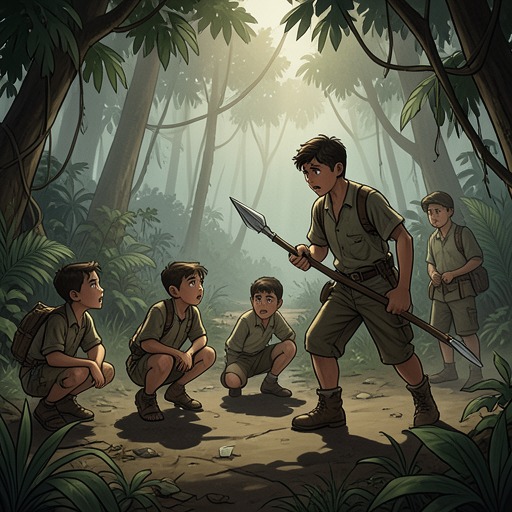
The disappearance of the birthmarked littlun
Lord of the FliesThe disappearance of the birthmarked littlun is the first irreversible human loss in the boys’ life on The island. It happens as their attempt to create a rescue signal becomes an uncontrolled forest fire. The child, distinguished by a mulberry-colored mark on his face and remembered as the littlun who spoke of snakes, is never seen again after the flames spread. The book does not show his death or establish it in a direct statement; instead, the loss emerges through Piggy’s alarm, the sudden silence of the assembly, and Ralph’s later knowledge that the boy is gone. That indirect presentation makes the disappearance a grim measure of how quickly the boys’ collective excitement has outrun their ability to care for one another.
Background: A signal fire out of control
The boys begin with no adults to direct them. At an early meeting, Ralph tells them they are on an uninhabited island and that they must look after themselves; Jack argues for hunters, while Piggy’s questions expose how little they know about their situation. Their first major collective undertaking is to make a fire on The mountain, hoping that its smoke will alert a passing ship. The signal is tied to rescue, but the boys have not yet worked out how to manage the danger or assign responsibility for watching the younger children.
The fire’s scale quickly exceeds its purpose. The boys feed it wood until flames rise high above the trees, sending sparks into the wind and consuming trunks. They have produced intense flame, but, as Piggy points out, not a useful smoke signal. The distinction matters: the group has concentrated on the spectacle of making a fire without securing the practical conditions needed to use it safely. Piggy says that the firewood has been spent and that they should have built shelters by the beach first. His complaint also reveals a failure of accounting: he had been asked to make a list of names, but the small children scattered before he could identify them all.
The child is noticed missing
As the fire continues to burn, Piggy turns from criticizing the boys’ priorities to asking after the littluns. He recalls one particular child, the boy who had talked about snakes and had a mark on his face, and says that he cannot see him. The question changes the assembly’s character. Until then, the fire has drawn the boys into a shared, almost playful rush of activity; now Piggy forces them to confront the possibility that someone has been left in the burning area. His question receives no answer.
Piggy’s alarm is sharpened by the circumstances he has just described. The littluns had been wandering near the fire, and no reliable count established who was present. He had not been able to complete the list alone, and their scattering made it impossible to know exactly how many children should be accounted for. Ralph says he had told Piggy to make the list, but accepts that the task was not completed. The exchange makes the disappearance more than a failure to notice one child in the moment: it exposes how little the group knows about its own members and how weak its arrangements are for protecting them.
The scene gives no account of the boy’s final movements. The fire growls; a tree explodes, and burning creepers leap into view. The littluns cry out that they see snakes in the flames, echoing the missing child’s earlier subject. Piggy repeats his question, now gasping and gripping a rock, while the boys look at one another in fearful disbelief. Ralph can only mutter that the child may have gone back to the other side of The mountain. The narration does not verify this explanation. The flames and the boy’s absence coincide, but no body is found and no witness reports seeing what happened to him.
The absence persists
The boy is not simply forgotten after the fire. Later, Henry plays in the sand with Percival Wemys Madison and Johnny, and the narration identifies him as a distant relative of the child whose mulberry-marked face had not been seen since the great fire. Henry is too young to understand the connection. Had someone told him that the missing boy had gone home in an aircraft, he would have accepted the story without fuss. The imagined explanation is not presented as what happened; it underscores the distance between the younger children’s understanding and the loss the reader can infer.
At a later assembly about the beast, Percival is brought forward as another small boy who must speak. His presence recalls the earlier child for Ralph. Ralph flinches at the memory and has to bring it back into view; he has pushed it out of sight, and only a strong reminder makes it return. The passage also explains why the boys have not produced a fresh count of the littluns: there is no reliable means of ensuring that all have been accounted for, and Ralph already knows the answer to at least one of Piggy’s earlier questions. The remaining children have faces free of major blemishes. The missing boy’s distinctive mark is absent from the group, and he has never reappeared.
Consequences and significance
The disappearance makes the cost of the first fire personal. A project intended to make the boys visible to rescuers instead becomes a danger they cannot control, while the child most vulnerable to that danger is precisely the one the group cannot account for. Piggy’s effort to make the boys face the absence briefly interrupts their excitement, but it cannot restore the child or provide certainty about his fate. The sequence turns a practical failure—an unmanaged fire and an incomplete roll call—into an enduring absence.
The narrative preserves that absence without converting it into a fully witnessed death. The evidence strongly implies that the boy perished in the blaze, but the story withholds confirmation, leaving Ralph to carry knowledge that he cannot easily voice and leaving the littluns without an explanation. In later scenes, the missing child returns through signs of memory rather than through action: the remembered birthmark, Ralph’s recoil, and the fact that no other child bears the same mark. The disappearance thus marks an early fracture in the boys’ claim to order. Their rules and plans are still being formed, yet the fire has already shown that collective enthusiasm alone cannot protect the people in their care.